Choosing the right Level of Framing for your work
The Fine Art Trade Guild is the Art & Framing industry standards body. It is their guidelines produced in conjunction with wide scientific research that has provided us with a 4 tiered system to assess roughly the expectant life of a work within its frame before it may degrade and require further inspection. The tiers are ranked accordingly:
Level 1 - (Ultimate protection) Also referred to as Museum grade framing. A life expectancy of 35 years minimum.
Level 2 - (High level) Often known as Conservation framing. A life expectancy of 20 years minimum
Level 3 - (Mid level) Using good quality methods and materials. A life expectancy of 5 years minimum.
Level 4 - (Low level) Budget framing using methods and materials that may be damaging to the work in the long term. No life expectancy.
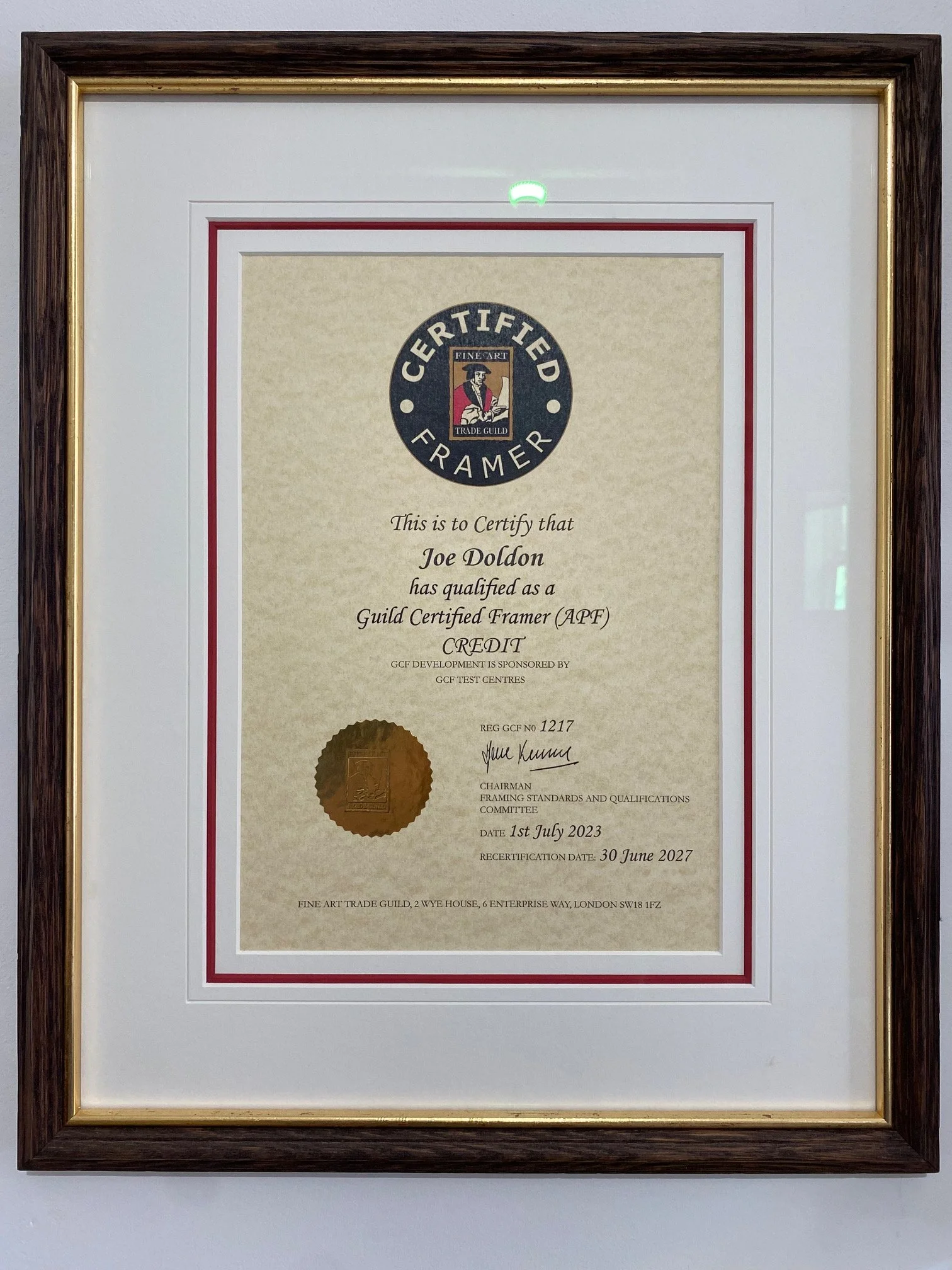
It’s very useful to have awareness of the ranking system, but it’s much more important for your framer to have a deep understanding of what combination of methods and materials are deemed necessary across different media types to qualify for each Level. Essentially, there’s many boxes to tick and therefore a lot of cross-over. The system is quite rigid and black and white - which is necessary to keep it relatable for the consumer, but in reality it’s very nuanced. Therefore I take the knowledge I have as a Guild Certified Framer and make my own best judgement rooted in that, and what the customer is happy to go with once I’ve provided them with the necessary information. For example, when it comes to choosing the right glass type, different printing methods and inks vary vastly in their lightfastness. Pencil drawings are completely immune to UV damage. However the guidelines remain the same for works on paper - only 97% UV protection or above will deem it Level 2 (considering all other criteria are met). Of course a large part of how well your work will be conserved are the conditions in which you place it. You should never hang work in direct sunlight, however even the difference between a filtered, but bright space is hugely different in accelerating UV damage than a dimly lit space.
The FATG recommends that original artwork should be framed to Level 2 or above. This obviously comes down to a decision by the customer who will know how much the item is worth to them both sentimentally and monetarily. However, if they’re prepared to pay for bespoke framing, the extra cost of a UV99 glass over standard float glass generally isn’t a huge proportion of the total cost. (The other costs to ensure a work on paper meets Level 2 criteria are menial).
A major decision that has direct impact on your artwork if being framed behind glass, is the quality of mountboard you choose. Again, The FATG rate these from 1 - 4. Levels 2, 3 and 4 are all made of wood pulp. The reason this is problematic in framing is that the lignin found in wood (a complex organic polymer) degrades to form acids. Level 4 boards (of which cream core falls into this bracket) have not received any treatment to mitigate this whatsoever. You will notice the bevel yellowing over time on cream core boards, which is a visual sign of this process in action. Acid leach onto the framed item will degrade and discolour at a fair rate. Level 2 and 3 boards have been buffered with an alkaline filler to help counteract acid attack. The difference between these boards is that the face paper, backing paper and core on a Level 2 board will all have received this treatment. A Level 3, only one or two of those will have been treated - although it is never made clear which one. Level 1 boards are made of 100% cotton and are known in the US as Rag mat board. These boards are inert and provide the best level of care for your artwork. Both the window mount and undermount must be cut from this to achieve Level 1 framing. This board should be used on original artwork of that holds relatively high monetary value, and objects that hold high sentimental value. Typically, I only use Level 1 and 2 boards, unless there’s a more suitable colour in Level 3 and the item is not an original artwork and doesn’t hold a great value to the customer.
Other threats to your artwork include humidity, Your work should ideally be hung in an environment between 40 and 60% RH. Bumpers of 3mm should be placed on the bottom 2 corners of your frame to allow airflow behind it. Otherwise, mould spots may begin to appear, and the likelihood of foxing is increased.
Having worked in other picture framers in the past, it’s clear to me that many framers don’t really have much of an understanding of how the materials and methods used within the framing package, as well as environmental threats can really have much of an impact on work. Generally, cost and time effective shortcuts are taken to ensure the best price for the customer, which always means the worst outcome. Fine if budget framing is all that’s required, but I’ve witnessed countless jobs where this has been applied to quality artwork and it makes me cringe to look back and think about it. As the Art and Framing industry is completely unregulated, the only way to ensure you’re receiving the right information and level of quality and craftsmanship that your work requires is to use a Guild Certified Framer.